
The ferry was supposed to leave at half seven. Mira had watched the harbour from her window, mug cooling in her hands, waiting for the engine’s low groan to break the silence. It hadn’t come. The harbour was flat. The sky was the colour of a bruise.
She’d been on Caill Isle for three days now, following a booking she’d made in October when the idea of a remote Scottish island cottage had seemed romantic. Restorative. The kind of place where you could write, or think, or simply stop. What she hadn’t expected was the stillness. Not peaceful stillness. The other kind. The kind that presses against the glass.
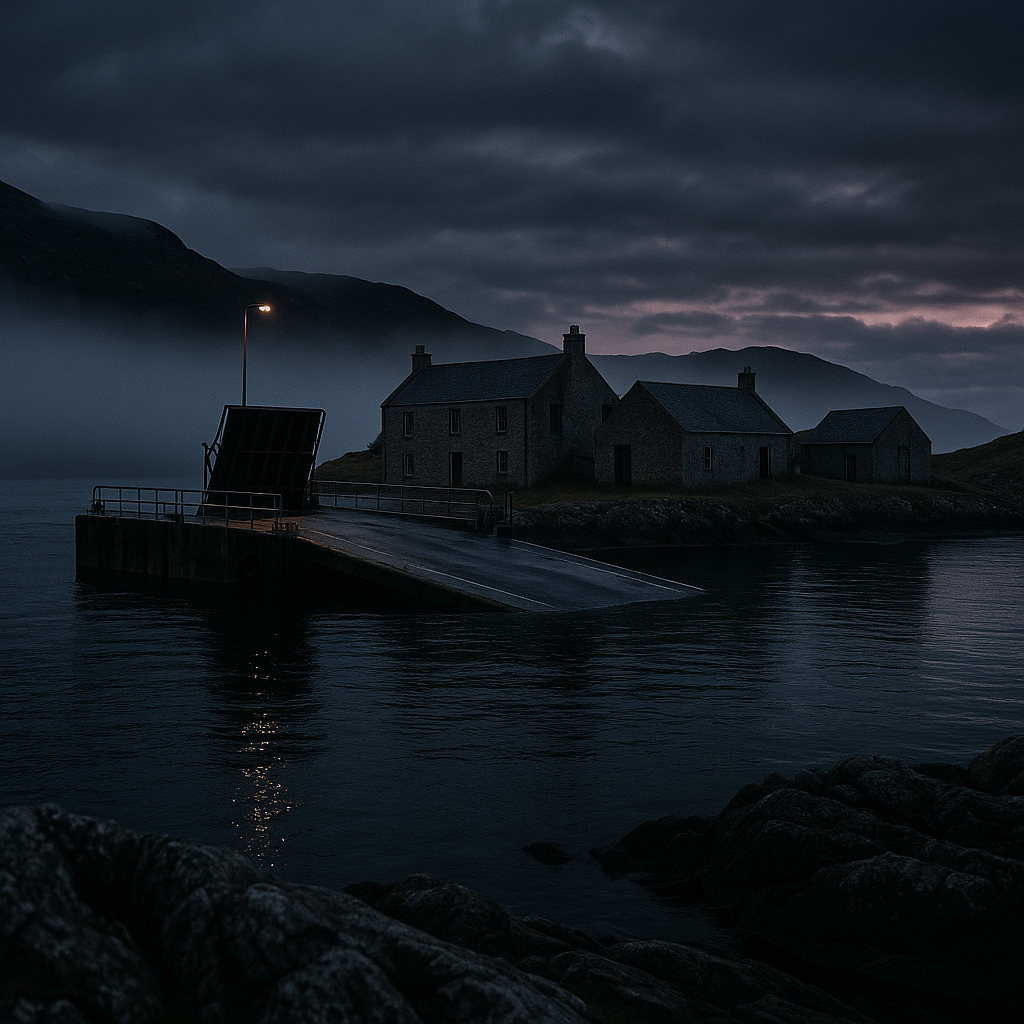
The woman at the post office had told her the ferry service was suspended. “Weather,” she’d said, though the sky that morning had been clear enough. The fishermen down at the slipway had not looked up when Mira walked past. The man who ran the only pub had pulled his door to before she could catch his eye. And her mobile had given up entirely on signal sometime around Tuesday, which meant that the book she’d downloaded before leaving the mainland, a locked-room thriller she’d been saving, was now her only real company.
It occurred to her that she’d read enough of the best historical horror novels to know exactly what kind of story this was beginning to resemble. That thought was not as comforting as she’d hoped.
What the bookshelf at the cottage held
The cottage came furnished with a bookshelf. Most of its contents were damp-swelled paperbacks with the spines read white, the sort of thing visitors leave behind because they can’t be bothered carrying them home. But buried behind a dictionary and something about birdwatching on the Orkney archipelago, Mira found three novels that felt almost curated. Almost deliberate. She read them in order, one per sleepless night, and by the third morning she was no longer certain whether the terror she felt came from the pages or from outside the window.
She’d always believed, as she’d written somewhere in the margins of an old notebook, that the best horror doesn’t need a monster. It needs a place. An enclosed, inescapable place, where the rules you arrived with quietly stop applying.
The best isolated setting horror novels UK 2026, a proper read-if-you-dare list
If you’re looking for the best isolated setting horror novels UK 2026 has to offer, the common thread across all of them is geography as dread. Islands, lighthouses, moorland, fog-locked valleys. The setting isn’t backdrop. It’s the mechanism.
The Salt Keeper by Catriona Haig (Hodder & Stoughton, January 2026) opens with a marine biologist arriving on a fictional island off the Outer Hebrides to catalogue a newly discovered seal colony. Within a fortnight, the colony is gone, two islanders have stopped speaking entirely, and the protagonist has begun finding drawings she doesn’t remember making. Haig writes landscape the way a surgeon works: precise, bloodless, then suddenly not. The island in this novel is never named, which is exactly right. A name would make it manageable.
Moor House by Daniel Pryce (Titan Books, March 2026) takes place across forty-eight hours on the North York Moors, in a former farmhouse that a family has rented for a long weekend. The roads flood on Friday evening. The novel proceeds in real time. Pryce is particularly good at the specific horror of ordinary domestic spaces becoming wrong: a light that won’t stay off, a room that smells different at night, a child who begins asking questions about the previous tenants with a precision she shouldn’t possess. If you’ve ever read the kind of fiction that works on grief and quiet unease simultaneously, Moor House belongs in that conversation.
The Wickham Light by Saoirse Devlin (Transworld, May 2026) is the year’s most formally inventive entry in the genre. Told through the maintenance logs of a fictional lighthouse off the Pembrokeshire coast, cross-referenced with letters written to a sister on the mainland, it builds dread so gradually that you don’t notice the temperature dropping until you’re already cold. The lighthouse keeper’s prose grows shorter as the novel progresses. By the final third, whole days are recorded in single sentences. Then half-sentences. Then marks on the page that aren’t quite words at all. The BBC Culture’s long-running examination of what makes literary horror actually frightening would find Devlin a useful case study: she answers the question through structure alone.
The Congregation at Kilmore by Andrew Speight (Bloomsbury, July 2026) is slightly different in texture. Set on a fictional island in the Inner Hebrides, it follows a disgraced Church of England vicar sent to cover a remote parish for the summer, only to find that the congregation holds services nobody has officially sanctioned and that the churchyard is considerably more active than churchyards are supposed to be. Speight has a dark wit that cuts through the fog in ways that make you laugh precisely when you shouldn’t. Think of it as the kind of book where you read a sentence, pause, and then read it again to make sure it said what you think it said.
No Signal by Priya Arora (Pan Macmillan, September 2026) is the most contemporary of the five, and the most visceral. A group of true-crime podcasters travel to a remote Shetland island to investigate a disappearance from the 1970s. Their equipment fails. Their group chat goes quiet. And the locals, when they can be found at all, seem to remember the 1970s event rather too clearly for people who were not alive then. Arora’s prose is terse and undecorated, which means the horror, when it lands, lands with full force. If the claustrophobic-community-keeping-secrets subgenre is your particular weakness, as it is mine, this one will cost you sleep.
Why isolation works so well in horror fiction
There’s something specific about island and moorland horror that mainland-set fiction can’t quite replicate. The reader knows, on some level, that an exit exists. That somewhere beyond the page there is a motorway, a Tesco, a mobile signal. Isolated setting horror removes that comfort entirely. The characters cannot leave. The reader, by extension, cannot leave either. You’re stuck in it together.
The writers doing this best in 2026 are also the ones interrogating community as a source of menace. The villagers who stop speaking. The pub that closes early. The ferry that doesn’t come. These novels understand that the most frightening thing isn’t the creature in the dark. It’s the neighbours who know something you don’t, and have decided not to tell you.
For readers who have already explored the folk horror territory of witchy fantasy fiction, these isolated setting suspense novels sit in adjacent but distinct territory: less magic, more menace, and geography doing the heavy lifting that spells might otherwise provide.
Back on Caill Isle
On the fourth morning, Mira woke to the sound of the ferry. She dressed quickly, grabbed her bag, and was at the harbour in seven minutes. The boat was real. The skipper nodded at her without expression. She climbed aboard and did not look back at the island.
She finished No Signal on the crossing back to the mainland. She read the last page as the harbour came into view, set the book face down on the bench beside her, and stared at the water for a long time.
Some books make you glad to be going home. Some make you wonder whether home is the sort of place that will hold you. The best isolated setting horror novels UK 2026 has produced manage, somehow, to do both at once.