
The notebook was bound in leather so old it had turned black. I found it wedged behind a loose brick in a cellar off Aldgate, during a renovation that probably should have been left undone. The handwriting inside was cramped, precise, and utterly cold. What followed was not a diary. It was something else entirely.
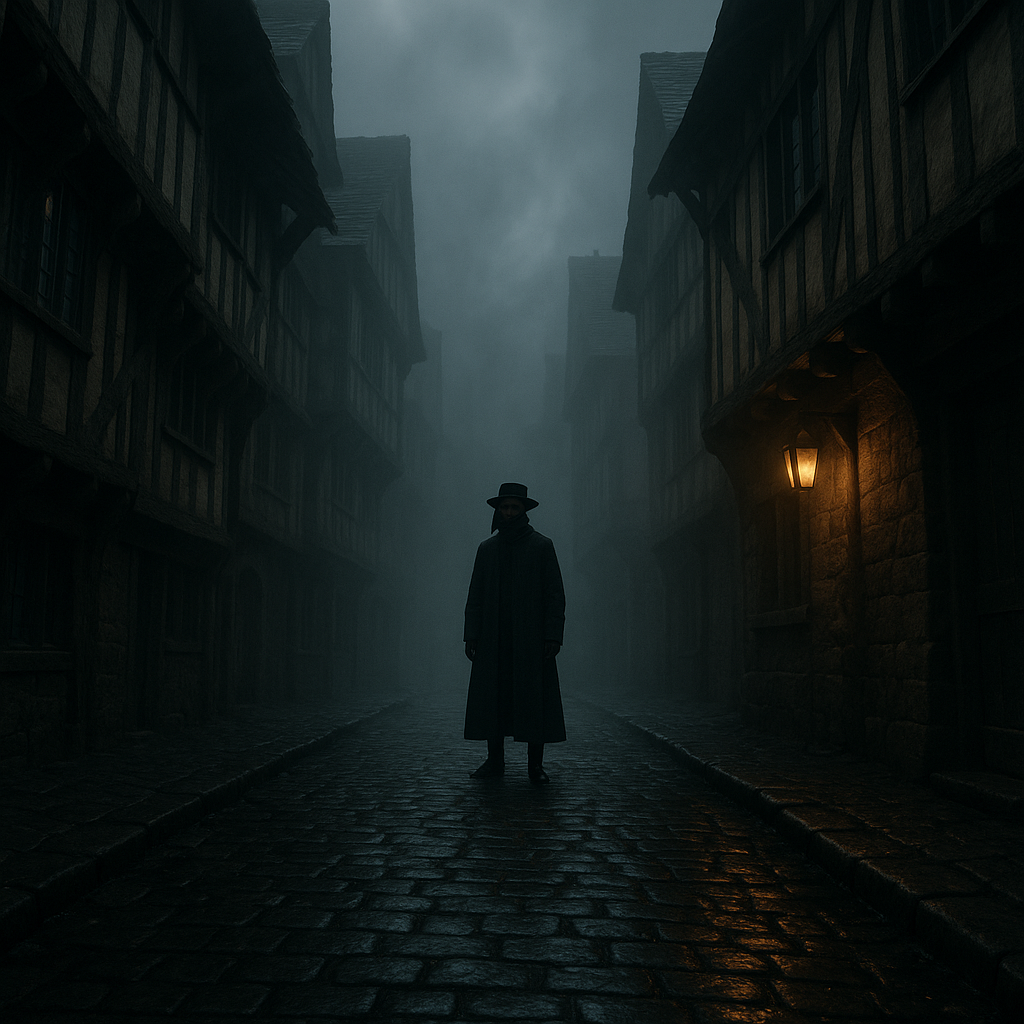
From the notebook: London, 1349
I move through the streets before dawn, because the streets are easier to bear before dawn. The birds have not yet learnt to avoid certain doorways. The dogs have not yet learnt either, but the dogs are fewer now. I wear the mask. The beak holds dried rosemary, cloves, camphor, a hedge against the pestilential air, or so we were taught. I have begun to doubt the teaching.
Bishopsgate this morning. A wool merchant and his two apprentices. I make the notations. I do not linger. There is a particular silence in a house where everyone has died within the same fortnight, a silence that is somehow louder than noise. You feel it in the chest before you hear it with the ears.
Brother Anselm at the priory says God is speaking. I told him I had not heard anything of the sort. He did not invite me back for supper.
The Thames smells of things I will not write. I walk west along it anyway, because the records must be kept. Somebody must count the dead, even if nobody reads the count. Perhaps especially then.
The best historical horror novels UK readers should have in their hands right now
Horror and history are a natural pairing. Put human beings under enough pressure, strip away everything modern comfort pretends is permanent, and what remains is genuinely frightening. The best historical horror novels UK publishers have brought out recently understand this. They are not dressed-up ghost stories with a period costume bolted on. They are books that use the past as the pressure chamber it actually was.
Here are the ones worth your time.
The Book of the Unnamed Midwife by Meg Elison
Technically post-apocalyptic, but the texture is deeply medieval in spirit, a world stripped back to survival and fear, narrated by a woman moving through ruins. Elison’s prose has the same cold precision I imagined in that plague doctor’s notebook. The horror here is systemic and intimate simultaneously. It has won awards quietly and deserves a wider UK readership.
The Plague Stones by James Brogden
This one is set in Birmingham and directly concerns the Black Death’s long reach into the present day. Brogden is one of the more interesting writers working in British folk horror right now, and this novel is probably his tightest. A family moves to a village that was granted immunity from plague through a dark covenant. The covenant, naturally, still holds. The atmosphere is genuinely oppressive in a way that feels earned rather than manufactured.
The House of the Dead by Simon Sebag Montefiore
Montefiore is better known for his non-fiction history, but this novel draws on his deep knowledge of tsarist Russia to produce something that reads like a fever dream set in a frozen empire. The horror is political as much as supernatural, and all the more unsettling for it. If you enjoy books that make you feel the cold, this is the one.
The Familiars by Stacey Halls
Set in Lancashire in 1612 around the Pendle witch trials, this is more gothic suspense than outright horror, but it belongs in this conversation firmly. Halls researched the actual trial records held at The National Archives, and that rootedness in fact gives the dread an unusual weight. What happened to those women was real. The novel does not let you forget it. Readers who enjoyed our short story exploring the best witchy fantasy books will find The Familiars a darker, more grounded companion.
The Long Drop by Denise Mina
Glasgow, 1957. A murderer, a city, and a trial that never quite made sense. Mina’s historical crime horror is meticulous in its period reconstruction and deeply uncomfortable in its implications about how cities absorb violence. The horror here is not supernatural but it is not lesser for that. The atmosphere of post-war Glasgow is rendered with a specificity that feels almost archaeological.
Dracula by Bram Stoker
Yes, it is 1897, and yes, you have probably heard of it. But Stoker’s novel earns its place in any serious list of the best historical horror novels UK readers can find, because reading it now is reading a document of its era as much as a story. The anxieties about immigration, disease, foreign contamination, the body as a site of violation, it is all there, and it lands differently once you have spent any time thinking about plague. Penguin Classics published a new annotated edition recently with contextual notes that genuinely add to the experience.
Back to the notebook: a few more entries
The plague doctor’s handwriting changes around the middle of the notebook. Becomes less regular. The entries grow shorter.
22nd day. Found a child alive in a house on Cheapside. She was sitting beside her mother, who had been dead some days. The child was unaffected. I have no explanation. I wrote it down anyway.
29th day. My own hands are steady. I do not know if this is fortunate.
38th day. The city counts its dead in the thousands now. I have stopped counting individually. The individual count becomes its own kind of madness.
The final entry is simply a date. Nothing after it. Whether that means he stopped writing, or stopped entirely, the notebook does not say.
Why historical horror hits differently
There is something specific about reading horror set in the past. The distance should make it safer. It does not. If anything, knowing that real people lived through the events being fictionalised makes the dread more textured. The Black Death killed roughly half of England’s population between 1348 and 1350, according to BBC History. That number, when you sit with it, is not an abstract statistic. It is a village where every other door stayed closed.
The best historical horror novels take that weight seriously. They do not use period settings as wallpaper. The setting is the argument. The past was not quaint. It was brutal, strange, and frequently terrifying, and fiction that remembers this does something that straightforward history writing often cannot: it makes you feel it.
Readers who enjoyed our exploration of mythology-retelling novels publishing in the UK will notice a similar thread running through the best historical horror, a need to return to old stories and find the blood still wet in them. And for those who found something in the atmosphere of Madeline Miller’s Circe, several of the titles above offer that same quality of deep time, of a world before the present arrangements were made.
The notebook is back behind the brick. I put it there myself. Some things are better kept in the dark, close to the ground, where they belong.
Frequently Asked Questions
What are the best historical horror novels set in the UK?
Strong choices include The Plague Stones by James Brogden, set partly in Birmingham, and The Familiars by Stacey Halls, set in Lancashire during the 1612 Pendle witch trials. Both use real British history as their foundation, which gives the horror genuine weight.
Are there good historical horror novels set in medieval Europe?
Bram Stoker’s Dracula engages with late-Victorian anxieties that echo medieval fears of pestilence and contamination, and remains one of the most richly historical horror novels available. For a more directly medieval setting, look into Umberto Eco’s The Name of the Rose, which leans into monastery-set dread.
What is folk horror and how does it relate to historical horror?
Folk horror is a subgenre rooted in rural British tradition, pagan ritual, and the uncanny power of the land. It overlaps heavily with historical horror because many of its most powerful settings are pre-industrial. James Brogden’s work is a good entry point for UK readers.
Is The Familiars by Stacey Halls a true horror novel or more of a thriller?
The Familiars sits on the border between gothic suspense and historical horror. It is based on the real 1612 Pendle witch trials and builds dread through atmosphere and period detail rather than supernatural set-pieces. Readers who prefer psychological menace over gore will enjoy it.
Where can I find more UK-focused horror and dark fiction recommendations?
The Dungeon Bookshop regularly publishes reviews and short fiction covering dark fantasy, spooky historical fiction, and gothic literature with a particular interest in British and European settings. Browse the Books and Spooky categories for more recommendations.