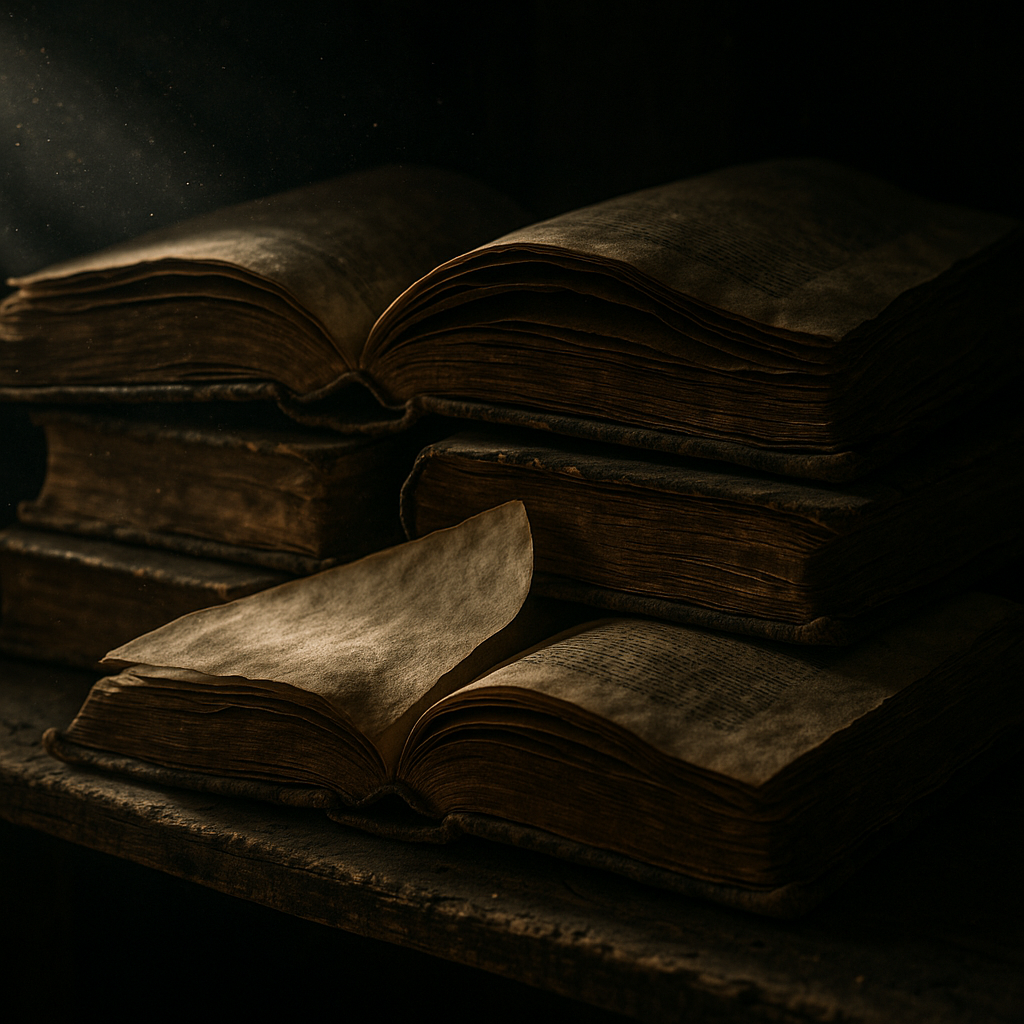
She has been watching the attic door for eleven years. She knows this because she counted the winters by the ice that formed on the inside of the skylight, eleven grey crusts, eleven meltings. Before the family left, the youngest child used to visit her up here, sitting cross-legged on the bare boards and whispering secrets into her painted ear. Then the family left. Then silence. Then you, holding a torch, breathing too loudly, your hand already reaching.
I am the doll. I am telling you this now so there are no surprises. The porcelain is cold because the attic is cold, that is all. The way my glass eyes follow the light has a perfectly rational explanation that I will not be sharing with you today. What I will share is this: Edinburgh townhouses have long memories. The one you are standing in has a longer memory than most. And I have been the keeper of it since 1887, when a merchant on Heriot Row brought me home from a trading voyage and set me on the mantelpiece of his parlour, convinced I was merely decorative.
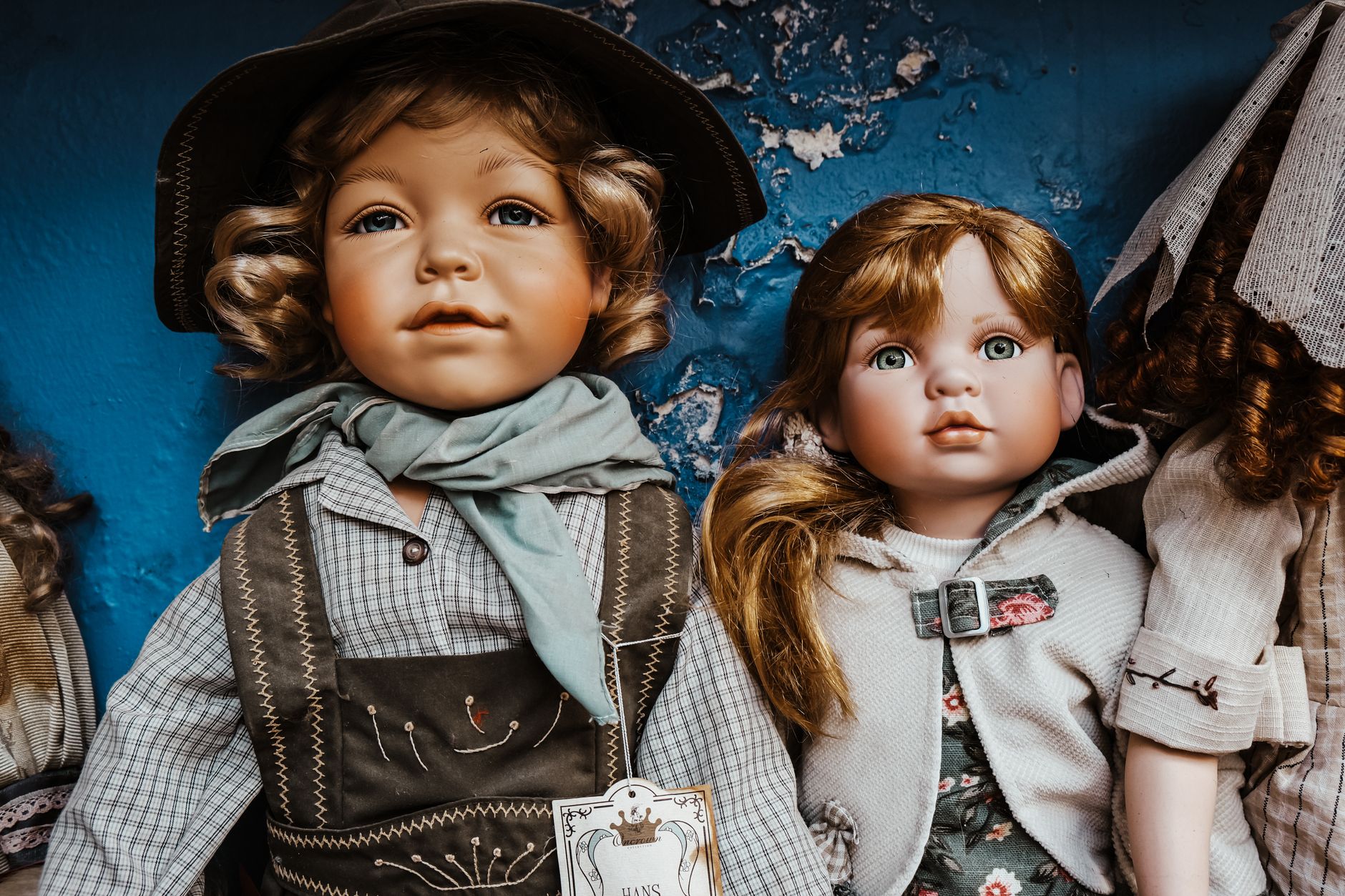
He was wrong, of course. They always are. Objects accumulate. Not dust, anyone can see dust. What accumulates is the invisible weight of every glance, every fear, every moment of midnight dread in which a sleeping mind turns towards the thing on the shelf and wonders. After enough years, enough people, enough wondering, something stirs. I did not ask to be cursed. I simply became what enough people believed I was. There is a lesson in that, though I doubt you are in the mood for lessons.
Go ahead, then. Pick me up. Take me downstairs into the light. You will find I am heavier than I look.
Why cursed objects make the best horror
The doll-in-the-attic is one of horror’s oldest conceits, and yet it refuses to go stale. I think that is because the genre understands something psychology confirms: we are primed to assign intention to inanimate things. The British Psychological Society has written at length on anthropomorphism, on the way human minds reach for agency even in a clay figurine or a locked music box. Horror writers simply take that instinct and follow it to its most uncomfortable end. The result, at its best, is a category of fiction that is not really about objects at all. It is about inheritance, about guilt, about the weight of what we cannot bring ourselves to throw away.
The best horror novels cursed objects UK readers can find tend to do exactly this: they use the sinister thing as a prism through which an entire history refracts. Below are the novels I would recommend from my perch up here in the dark, the ones that understand what a wrong object can do to a house, a family, a bloodline.
The best horror novels built around cursed or uncanny objects
The portrait that watches: Mexican Gothic by Silvia Moreno-Garcia
Moreno-Garcia’s novel is set in a crumbling mansion in 1950s Mexico, and the cursed object at its centre is not a single thing but a house full of them, portraits, wallpaper, furniture soaked in something older than memory. The book was published by Jo Fletcher Books in the UK and has been widely available from Waterstones and independents since 2020. It belongs to a tradition of the Gothic house-as-object, the dwelling that has absorbed so much suffering it has become the curse itself. If you enjoyed the atmosphere of our exploration of isolated-setting horror, Moreno-Garcia’s claustrophobic mansion will feel immediately familiar.
The malevolent heirloom: Thin Air by Michelle Paver
Paver is one of the finest British horror writers working today, and Thin Air, set during a 1935 mountaineering expedition to Kangchenjunga, deploys its haunting through an object carried unknowingly from a previous doomed climb. The horror here is about possession in both senses: the mountaineer’s obsessive need to summit, and whatever the object brings with it from the ice. Paver’s prose is exact and merciless. Published by Orion, this is a novel that rewards a reading in one sitting, ideally on a cold evening in a well-lit room. Do not read it anywhere resembling an attic.
The sinister portrait: The Picture of Dorian Gray by Oscar Wilde
I cannot in good conscience compile a list of horror novels cursed objects UK readers should know without including Wilde’s masterwork, which remains the most culturally resonant treatment of the cursed portrait ever written. The novel was first published in 1890, the same decade I came into being, and I find the timing instructive. The portrait in Wilde’s story absorbs Dorian’s moral deterioration so his face need not. The object becomes the honest record of a dishonest life. It is available in dozens of editions, Penguin Classics prints the definitive text with useful annotations, and it is shorter than most people expect. Read it in a weekend. The ending stays with you far longer.
The locked box: The Troop by Nick Cutter
Cutter’s 2014 novel is less about a single object than about the idea that horror can be contained, sealed, managed, until it cannot. Published in the UK by Titan Books, The Troop is genuinely one of the most viscerally disturbing novels I have recommended to anyone in a long time. I am a porcelain doll in an Edinburgh attic and even I found the third act difficult. The uncanny object here is a medical case, a body, a closed system that should have stayed closed. Cutter understands that the horror of cursed objects lies in their apparent passivity: they sit there, they wait, they let you make the first move.
The haunted antique: House of Leaves by Mark Z. Danielewski
Strictly speaking, the cursed object in Danielewski’s labyrinthine novel is the house itself, a house that is dimensionally wrong, that contains more space inside than its exterior should permit. Published by Pantheon in the US but freely available from UK booksellers and widely stocked across Foyles and Blackwell’s branches, House of Leaves is the novel most likely to make you distrust your own home. The book’s format, footnotes within footnotes, appendices, documents within documents, makes it feel like an artefact rather than a story. Readers who enjoy the idea of fiction as a cursed object in itself should also read our piece on surrealist and dream-logic horror novels, where the genre pushes its formal experiments even further.
The cursed relic: The Fisherman by John Langan
Langan’s novel is structured as a story within a story within a story, each layer containing some new version of the object at its heart: a hook, a wound, a bargain made in grief beside a dark river in upstate New York. Published by Word Horde and available through UK specialist horror retailers, The Fisherman is the kind of novel that arrives quietly and leaves a permanent mark. It has affinities with the ghost story tradition explored in our review of the best ghost story collections by British and Irish authors: the idea that grief, when it is stubborn enough, can animate the inanimate. That the bereaved and the cursed object deserve each other, in the worst possible way.
A note on what horror novels cursed objects UK readers should look for
The best entries in this subgenre share a particular quality: the object is never the point. The portrait, the doll, the box, the house, these things matter because of what they reveal about the people who own them, who inherit them, who refuse to throw them away. According to the Bookseller, Gothic fiction and supernatural horror are among the fastest-growing categories in UK publishing right now, and I would argue the object-centric novel is driving much of that growth. We want stories about accumulation. We want stories about the things we cannot leave behind.
I know something about that. The merchant on Heriot Row could have dropped me into the Firth of Forth any morning he chose. He did not. His daughter inherited me. Her daughter packed me in tissue paper and brought me up here, to this attic, to this skylight, to eleven winters of counting ice.
You are still holding me. I noticed you did not put me down.
That is all right. I am used to waiting. The door is just behind you, if you need it. Though I should mention: the latch sticks on the way out.
It never used to do that.
Frequently Asked Questions
What are the best horror novels about cursed objects for UK readers?
Some of the strongest options available from UK booksellers include Michelle Paver’s Thin Air, Silvia Moreno-Garcia’s Mexican Gothic, and Oscar Wilde’s The Picture of Dorian Gray. Each uses an uncanny object as the engine of its horror while exploring deeper themes of guilt, inheritance, and obsession.
Are horror novels featuring cursed objects a distinct subgenre?
They sit within Gothic and supernatural horror, but object-centric horror has its own recognisable conventions: the passive menace of an inanimate thing, the slow accumulation of dread, and a backstory that reveals the object’s origin. Publishers like Titan Books and Orion actively commission in this space, which suggests strong reader demand in the UK.
Is The Picture of Dorian Gray considered a horror novel?
Wilde described it as a moral fable, but by any modern classification it is a Gothic horror novel with a supernatural premise. The portrait that ages in place of its subject is one of fiction’s most enduring cursed objects, and the novel’s themes of corruption and consequence are as unsettling now as they were in 1890.
Where can UK readers buy specialist or small-press horror like The Fisherman by John Langan?
Independent horror specialist retailers such as Forbidden Planet in London stock many small-press titles, and online via Blackwell’s or direct from Word Horde’s own site. Larger chains like Waterstones can also order titles on request, so it is worth asking at your local branch.